

Contents
How to Open a Bottle of Wine: Cork, Screw Cap, and Sparkling
Have you ever stopped, bottle in hand, unsure how to get it open?
- "How far do I screw in a corkscrew?"
- "The sparkling wine cork looks like it might fly off — is it dangerous?"
- "A screw cap — do I just twist it?"
The first sparkling wine I ever opened, the cork shot out. Nearly half the bottle foamed away. What I remember from that night isn't the taste — it's the waste. Opening a bottle is easy once you know the order. It's only the first time that you don't.
The short version: there are three kinds of closure. Cork: screw in, lever it out. Screw cap: hold the bottle, twist the cap. Sparkling: chill it, thumb on the cork, go slowly. In every case, order matters more than force.
First, the answer: how to tell the closure, and how to open it
Closure | How to tell | How to open | Watch out for |
|---|---|---|---|
Cork | A cork under a foil capsule | Screw in a waiter's corkscrew and lever it out | Don't screw through; don't go in at an angle |
Screw cap | A metal cap with a screw thread | Hold the bottle and twist the cap | Twist the cap only, not the bottle |
Sparkling | A cork held by a wire cage (muselet) | Chill it, thumb on the cork, twist the bottle | Never point it at anyone; never open it warm |
Once you know the closure, the method is decided. Look at the top of the bottle. Start there.
Cork: five steps
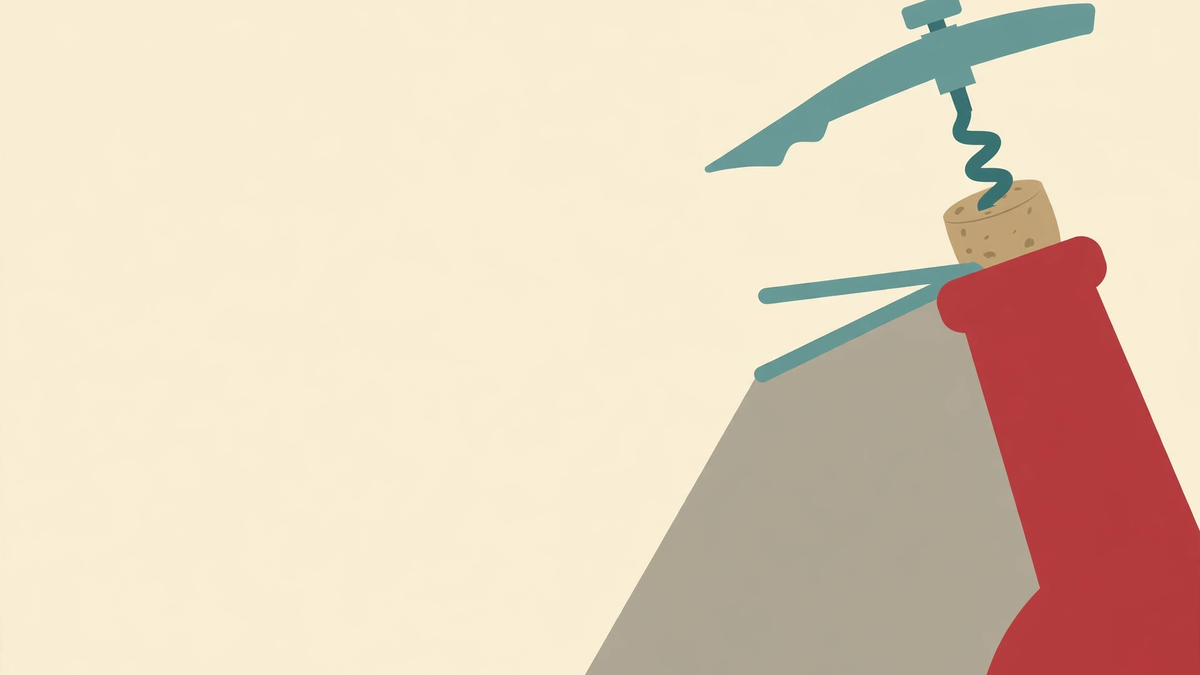
Cut the foil. Use the small blade of a waiter's corkscrew and cut once around, just under the lip of the bottle. Peel the cut foil down and off. Resting the blade on the lip keeps the cut straight.
Stand the screw in the centre. Place the screw dead centre on the cork, straight up. If it goes in at an angle, the cork is likely to split. If the centre is hard to find, look at the top of the cork once before you start.
Screw it in. Stop before the tip breaks through the bottom of the cork — roughly when the spiral is almost all the way in. If it breaks through, crumbs fall into the wine.
Rest the lever on the lip. Set the lever's step on the bottle lip and lift the handle slowly. Don't pull with force. Let the lever do the work.
Re-seat the lever halfway. When the cork is about half out, move the lever to its second step and lift the rest of the way. Ease the last bit out by hand. Smell the cork when it's out — it tells you something about the wine. A sharp vinegary smell may mean the wine has turned.
Screw cap: just twist — but hold the bottle
A screw cap is just a twist. No tools needed. Hold the bottle firmly in one hand, though. If the bottle turns with the cap, the cap just spins. When the perforated band snaps with a small crack, it's open. Sometimes a bit of the seal stays inside the cap — wipe the mouth of the bottle lightly before pouring.
Sparkling: chilling is half the job
A sparkling cork is pushed up by the gas inside the bottle. Before opening, chill it first — a few hours in the fridge. Open it warm and the foam rushes out.
Thumb on the cork before loosening the wire. The moment the wire comes off, the cork can fly on its own. Keep your thumb on it.
Loosen the wire slowly. Twist the little loop to slacken it, then take the cage off. Don't lift your thumb.
Cover it with a cloth and hold the cork. If it does fly, the cloth catches it. Grip the cork through the cloth.
Twist the bottle, not the cork. Holding the cork still, slowly turn the bottle. A soft "psshh" as the gas escapes means you did it right. The louder the pop, the more the wine foams. The quieter it is, the calmer the wine stays.

Three mistakes people make when opening wine
Screwing the cork in at an angle. Off-centre, the cork splits and crumbs drop in. Rather than fixing it, stand the screw in the centre from the start. Rushing the screw in is usually what makes it go crooked.
Shaking sparkling wine before opening it. Shaking whips up the gas. Chill it, set it down quietly, then open it. Don't carry it on its side, either.
Pointing the cork at someone while opening it. A flying cork is faster than you think. Aim it where nobody is. Don't aim it at a ceiling light, either.
If the cork breaks
If the cork snaps halfway, don't force what's left. Screw into the remaining cork again and lever it out a second time. If that still fails, push the cork into the bottle and pour through a tea strainer. A few crumbs don't change the taste. No need to throw the bottle away in a panic.
FAQ: opening a bottle of wine
Q1. I don't have a waiter's corkscrew. What else works?
A T-shaped corkscrew works too — screw it in and pull straight up. With a winged type, lower the wings first, then push the handles down. Whichever you use, the one rule is the same: don't go in at an angle.
Q2. The cork is crumbling and the screw won't grip.
Old corks go soft and crumbly. Don't screw in too deep; go in shallow and lift slowly. If it won't come out, switch to pushing the cork in and straining as you pour.
Q3. I opened a sparkling wine and the foam won't stop.
Either the bottle was warm or it was shaken. Put the cork lightly back on and chill the bottle in the fridge. When you pour, tilt the glass and pour slowly — the foam settles.
Q4. How should I keep a record of the wine I just opened?
Photograph the label right there, as soon as the bottle is open. In POURPIN, a label photo reads the name, producer, region, and importer for you. Stars and Hints can be added later, after you taste it. Jot the opening date in a memo, too — it helps you judge how long the wine keeps.
→ Opened wine: how long does it keep? A guide by type, and how recording the opening date saves wine
→ Your first wine glass: a guide to shape, stem, and washing

In short
- Three closures, three methods. Order matters more than force.
- Cork: stand the screw in the centre and lever it out. Screw cap: hold the bottle and twist.
- Sparkling: chill it, thumb on the cork, twist the bottle. Never point it at anyone.
Today's one action: before you open tonight's bottle, check its closure. Cork, screw cap, or sparkling? Once you know the kind, the method is decided.
Record the bottle you just opened, right there. POURPIN lets you record up to 30 bottles for free — or 3 as a guest, no sign-up needed. A label photo reads the name, producer, region, and importer. Stars and Hints can be added after you taste it. And when your records pile up, Premium (¥300/month or ¥3,000/year) adds detailed search and Export (CSV/JSON).
Ready to start logging your wine journey?
Log up to 30 wines for free with POURPINNeed more? Premium: unlimited + export for $2.99 USD/month
- Google Play
- App Store


