

Contents
- Whose average is that score?
- The four mechanisms behind the drift
- The drift, seen in two cases
- Why your own stars never drift
- Three steps to use other people's scores well
- Three mistakes of score-first drinking
- Bonus — You don't have to throw scores away
- FAQ — Wine scores and taste Q&A
- Summary
- Today's one action
- Start now
Why a 4.0 Can Still Miss Your Taste — Why Wine Scores Differ from What You Like
Have you ever opened a wine rated 4.0 and tilted your head in confusion?
- "It was highly rated, but it just wasn't for me"
- "A low-rated wine turned out to be one I loved"
- "I don't trust my own taste yet, so I keep leaning on scores"
Your palate isn't dull. It's a problem with how scores are made.
Here's the conclusion up front. A published wine score is an average of ratings from an unspecified crowd. An average is nobody's taste — not yours, and not any single person's. So of course it drifts from what you like. Once you see the mechanisms behind the drift, you can stop being pushed around by scores and choose on your own axis.
Whose average is that score?
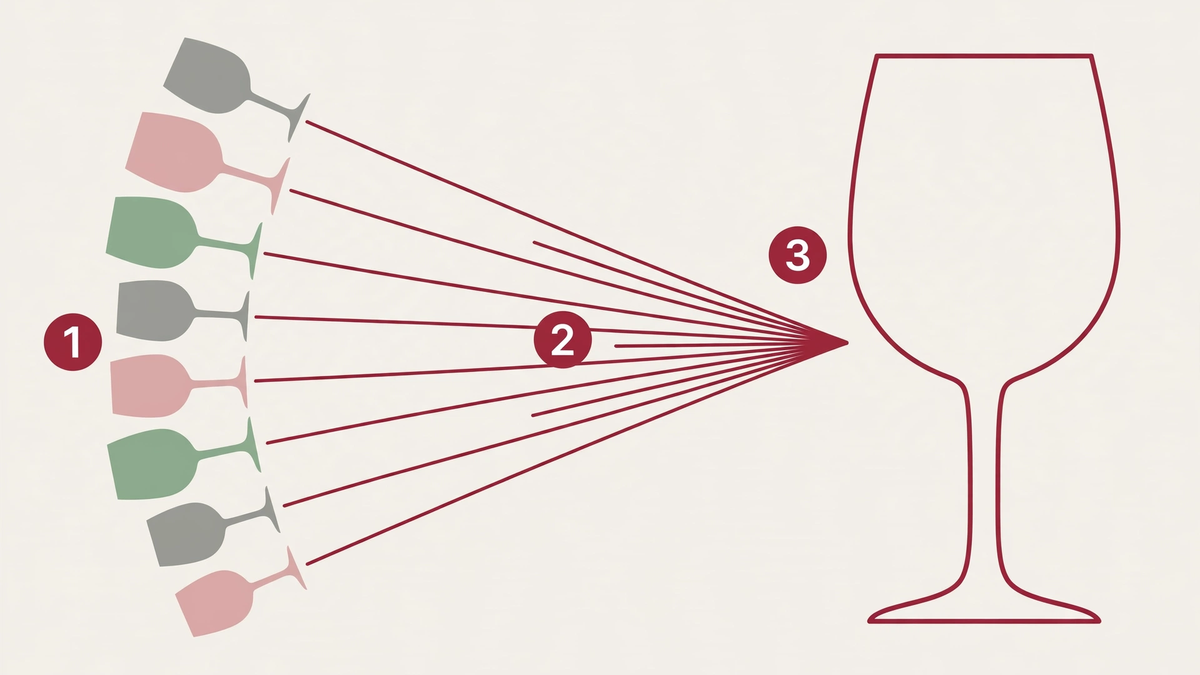
A published score gathers the ratings of many people and compresses them into one number. Mixed into that number are each person's taste, their wine experience, and the situation in which they drank it.
The same wine gets different ratings from someone who usually drinks heavy reds and someone who prefers light whites. The dish on the table that day, or how tired they were, shifts it too. All of that, averaged together, is what shows up on screen as "4.0."
An average is a handy guide, but it is nobody's taste. There was never any guarantee it would match yours.
The four mechanisms behind the drift
Scores drift from your taste through four main mechanisms.
Mechanism | What happens | How to miss less |
|---|---|---|
1. The rating crowd differs from you | The people rating it differ from you in taste and experience | Look at what flavors people mention, not just the number |
2. The drinking context differs | Food, occasion, temperature and condition change how the same wine feels | Look for ratings from situations close to yours |
3. Price bias | Knowing a wine is expensive makes it taste better; knowing it's cheap makes you harsher | Treat price as information for before you buy, nothing more |
4. Same label, different year or storage | Vintage and storage change what's inside the bottle | Compare the rated vintage with the vintage of your own bottle |
Context, mechanism 2, is the one people overlook. The same wine feels different at an anniversary dinner and on a tired weeknight. A score is the average of all those contexts, jumbled together.
The drift, seen in two cases
Line up two cases. Read them not by score, but by your own Hints — the tap-to-select tasting words — and the drift becomes visible.
Case | What the public score suggests | Your Hints | Re-reading |
|---|---|---|---|
A 4.0 you didn't enjoy | Everyone rates it highly | tannin, powerful, dry | You simply dislike astringency and weight. It doesn't match your axis |
A 3.5 you loved | Unremarkable on average | cherry, smooth, fruity | It matches your axis (fruit and smoothness). A low score doesn't matter for you |
In neither case is your sense wrong. Liking isn't decided by how high a score is. Look at the shape of your own Hints, and "what I experience as like" turns into words.
Why your own stars never drift

Now, about POURPIN's stars.
POURPIN stars are never published. They never get folded into anyone else's average. They are ratings for use inside your own records only. So a star is never compared against a crowd's average — it's only compared against your own past.
If a public score is "an average of strangers," your own star is "your own history." Compare a wine you gave 5 stars a year ago with one you give 5 stars now, and you can see how your taste changed. It never drifts, because the thing you're comparing against is always yourself.
To keep records for yourself alone, start free — up to 30 bottles. Your records are never published.
Three steps to use other people's scores well
You don't need to throw scores away. Just move where you put them.
- Use a score only as the entrance to narrow candidates. Its job is to cut hundreds of bottles down to a few that interest you.
- Look at the breakdown, not the number. Read what flavors people mention and in what situations they drank it. Words are easier to hold against your own axis than a number.
- Finally, check it against your frequent Hints. Does the description of the candidate match the Hints you pick often (for example cherry, smooth)? That's the deciding factor.
If you don't yet know your frequent Hints, the 5-bottle taste-type diagnosis is the shortcut.
→ Find Your Wine Style in 5 Bottles
Situation | Use the score? | Look at instead |
|---|---|---|
Narrowing candidates to buy | Yes, as an entrance | The score plus a match with your Hints |
Choosing in a shop | Mostly no | The shop's description and your frequent Hints |
Logging after drinking | No | Your own stars and Hints, and the occasion |
Three mistakes of score-first drinking
- Buying on the score alone. A score is an entrance, not a decision. When entrance and decision are the same thing, you can't tell why you missed.
- Not recording the wines you disliked. A miss is your map of what you dislike. Without it, you'll buy the same type again.
- Adjusting your own rating to match the average. "Everyone says it's good, so I'll bump my star up" is the fastest way to break your own axis. Leave your star exactly as you felt it.
Bonus — You don't have to throw scores away
Scores are useful as an entrance to discovering regions and labels. They can introduce you to a region you'd never have tried.
Don't throw them away — just put them back at the entrance. The decision goes to your own stars and Hints. Once you can make that split, scores stop pushing you around.
FAQ — Wine scores and taste Q&A
Q1. Should I just not buy highly rated wines?
Buy them if you like. Just keep the score at the entrance, where it narrows candidates. The final call is whether it matches your frequent Hints.
Q2. My star and the public score were exact opposites. Which is right?
Inside your own records, your star is right. The public score is other people's average, and it isn't material for deciding your next bottle. Opposite isn't wrong — the axes are different.
Q3. Are score sites lying?
No — they're averaging. A number made by gathering many people's ratings will sometimes drift from your taste. That's all. Once you see the mechanism, you neither need to doubt scores nor to believe in them blindly.
Q4. How do I build my own axis?
Compare the Hints across 5 bottles — that's the shortcut. The more records you keep, the thicker your axis gets. Start tonight: give tonight's bottle your own star and Hints.
Summary
- A public score is an average of strangers — it is not your taste
- The drift comes from four things: the rating crowd, the context, price, and year/storage
- Put scores at the entrance; put the decision on your own stars and Hints
Today's one action
Give tonight's bottle your own star and Hints — including a bottle you missed on.
Without looking at anyone's score, rate it on your own feeling alone. That's the first step of your axis.
Start now
Try it free first
→ Sign in free at pourpin.fun (log up to 30 bottles). Your stars and Hints are never published.
To keep your records as an asset
→ Premium: unlimited records + Export (CSV/JSON). A history of your axis, kept in your own hands.
Ready to start logging your wine journey?
Log up to 30 wines for free with POURPINNeed more? Premium: unlimited + export for $2.99 USD/month


