

How to Revisit Your Favorite Wine | 30-Second Logging Even When You Forget the Name
For those who love wine but always forget the names.
That glass you had at the restaurant.
You remember it was "delicious." But the name won't come to you.
- "Where's that label photo in my camera roll...?"
- "It was a red something, umm, not too tannic..."
It's not a problem with your memory. Most people can't accurately remember wine names.
In fact, many people struggle to recall the names of wines they enjoyed afterward.
The solution: Log it, and you can revisit it. And it only takes 30 seconds.
Wine Logging in 30 Seconds (PourPin 30-Second Rule)
PourPin 30-Second Rule (Fixed Set)
1. Front photo
2. Save
Just these 2 steps. Use the same pattern every time.
No confusion means you'll keep doing it. Keep doing it, and you can revisit.
Step Table: 30-Second Breakdown
Step | Action | Time |
|---|---|---|
1 | Scan label (AI reads it) | 15-20 sec (depends on connection) |
2 | Save | 2 sec |
Total | ~20 sec |
No need to write lengthy Notes.
These 2 items become "a letter to your future self."
Why Photos Alone Can't Get You Back to "That Wine"
Photos are certainly convenient. But when you scroll back through your camera roll 3 months later, this happens.
- You can't read the label text (French wines don't even list grape varieties)
- You can't remember where you drank it
- You have no information beyond "it was good"
Taste memory is generally considered harder to recall than visual or auditory memory.
Moreover, it's said that the amount of taste information you can hold at once is very limited.
In other words, if you don't log it the moment you drink it, it's almost gone.
Conversely, when you preserve location and context together, memory comes back more easily.
The context of "at that place" and "with that person" becomes the key to retrieving taste memory.
This is why you should preserve Where + store name.
And the act of writing itself helps consolidate memory.
Logging isn't just "to remember later" - it's also "to make it harder to forget."
Logging Tips That Reveal Your Wine Preferences
 Tips
TipsChoose 4 Hints. Here's the breakdown.
- AROMAS (scent) 2 items: e.g. berry + vanilla
- PALATE (mouthfeel) 1 item: e.g. smooth
- FINISH (aftertaste) 1 item: e.g. medium
All chip-based selection. No need to write sentences.
When you continue this for 5, 10 bottles, your "preference pattern" emerges.
Once you know "I seem to like the combination of berry and smooth," it becomes a criterion for choosing wine next time.
When your favorite Hints pattern becomes visible, you can reach for similar varieties.
Logging isn't just looking back at the past - it's a tool that changes future choices.
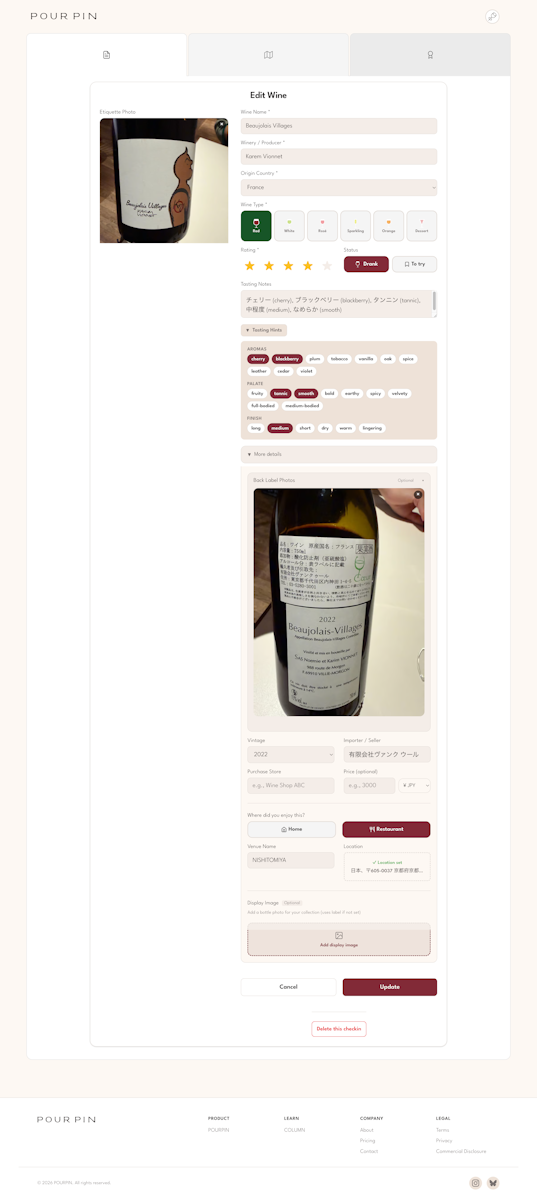 ↑ pourpin editor screen
Examples: Log Like This (OK to copy as-is)
Example 1: Red wine at a restaurant
- ★: 4
- Type: Red
- Where: Restaurant / Bistro XX
- Hints: cherry, vanilla, smooth, medium
Example 2: White wine opened at home
- ★: 3
- Type: White
- Where: Home
- Hints: citrus, floral, crisp, short
Example 3: Sparkling wine discovered at a bar
- ★: 5
- Type: Sparkling
- Where: Bar / Wine Bar △△
- Hints: apple, toast, refreshing, long
3 Things People Who Can't Maintain Wine Logs Tend to Do
1) Try to write long notes
If you start writing "Rich fruitiness, restrained acidity, tannins are..." you'll stop by the third bottle.
→ Just 4 Hints chips is enough. That's sufficient.
2) Take a photo and feel satisfied
Photos buried in your camera roll become just image data after 3 months.
→ Add ★ and Hints. Just that turns it into "searchable records."
3) Don't preserve location or context
When "when, where, with whom" is missing, you can't retrieve taste memory.
→ Enter Where + store name. Context becomes the key to memory.
Supplement: The Real Reason Wine Names Are Hard to Remember
French wines often don't list grape varieties on their labels.
There's a custom of calling them by region name.
Furthermore, the same variety has different names in different countries.
For example, Syrah and Shiraz are the same grape.
In other words, "remembering by name" itself is hard mode.
That's precisely why logging in your own words (Hints) is realistic.
FAQ | Questions About Wine Logging
Q1. What should I write in tasting notes?
You don't have to write anything. If you select 4 Hints chips, that becomes your tasting note.
If you really want to leave a word, something like "paired well with meat" in Notes is sufficient.
Q2. What if I can't read the wine name / AI scan fails?
It's OK if you can't read it. Even if Scan fails, you can still revisit with photo + ★ + Hints.
You can also ask the server "what is this" and enter it manually.
Q3. Isn't 30 bottles too few?
At 1 bottle per week, that's about 7 months. More than enough to get started.
If you really stick with it, you can switch to Pro ($2.9/month) for unlimited + Export.
Q4. Is logging meaningless when you have few records?
It's meaningful from bottle #1.
To revisit "that one bottle," all you need is one single record.
After 3 bottles, preference trends start to emerge. By 5, it becomes certainty.
Summary
- Forgetting the names of wines you liked isn't just you
- Photo + ★ + 4 Hints 1-minute logging turns "I want to drink again" into "I drank it again"
- Logging isn't preserving the past - it's preparation for future reunions
Today's 1 Action
Tonight's bottle → Scan → ★ → 4 Hints → Save.
Get Started
Try it free first
→ Free login at pourpin.fun (log up to 30 bottles)
If you're serious about continuing
→ Pro $2.9/month: Unlimited logs + Export (insurance for your taste history)
Free | Pro ($2.9/month) | |
|---|---|---|
Logs | Up to 30 | Unlimited |
AI Scan | ○ | ○ |
Hints | ○ | ○ |
Sort | − | ○ |
Export | − | ○ |
Ready to start logging your wine journey?
Log up to 30 wines for free with POURPINNeed more? Premium: unlimited + export for $2.99 USD/month

